MusclePharm sells creatine monohydrate in two versions, and the outside reviews disagree about them. If you’re a man over 40 searching for MusclePharm creatine monohydrate reviews, here is the short version: Select Creatine ($29.99, unflavored) and Creatine-Hydrate ($34.99, two flavors) both list 5 grams of creatine monohydrate per serving, and each tub holds 60 servings. The fitnesshealth.co review is favorable. The Supplements Tested review does not recommend the MusclePharm creatine it covered, which may be a different blend from either tub. The rest of this page covers the label, the warnings, the cost per serving and what to check before you pay.
Affiliate disclosure: Plainly, this page uses affiliate links. We may earn a commission when you buy through these links. This costs you nothing extra.
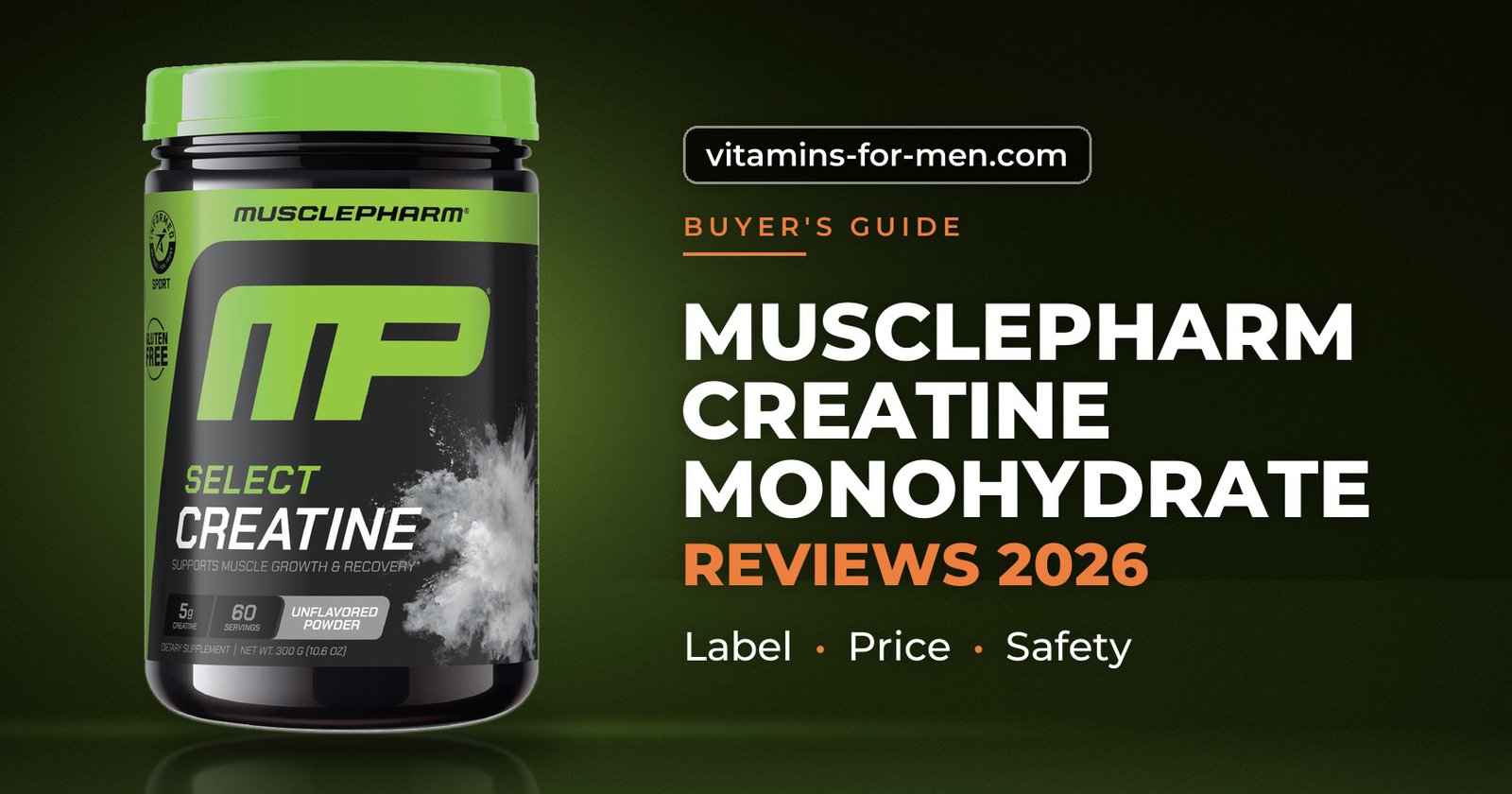
MusclePharm creatine monohydrate at a glance
Prices as of November 3, 2026; check the checkout for today’s price.
| Item | Select Creatine | Creatine-Hydrate |
|---|---|---|
| Price | $29.99 | $34.99 |
| Flavor | Unflavored | Strawberry Watermelon, Fruit Punch |
| Servings per container | 60 | 60 |
| Serving (scoop) size | 5 g | 7.6 g |
| Creatine monohydrate per serving | 5 g (5,000 mg) | 5 g |
| Price per serving | $29.99 ÷ 60 = $0.50 | $34.99 ÷ 60 = $0.58 |
| Product Page | Product Page | Product Page |
What is creatine, and who does it fit?
Harvard Health Publishing describes creatine as one of two amino acid derivatives, along with carnitine, found in supplements aimed at energy. Of these, it says, creatine is “the one that may have some athletic benefit.” The same article says creatine “contributes to rapid energy production and may enhance power or speed bursts” (Harvard Health on athletic supplements). Your body also gets some creatine from food. The Supplements Tested review says creatine is “readily available in meat and fish.”
Both MusclePharm pages frame creatine around training: strength, power and workouts. The Select Creatine page says it is “only intended for use by healthy adults over 18 years of age.” If you’re over 40, read should you take creatine after 40 before you decide. For the study detail, see creatine human studies and safety (our research library).
What is in the tub?
Select Creatine
The Select Creatine page lists a serving size of 5g (1 scoop), 60 servings per container, and Creatine Monohydrate 5,000mg (5g) per serving. The seller describes it as “micronized creatine monohydrate.” The page says it “has no taste or odor.” The page also warns that it “was produced in a facility that may also process ingredients containing milk, eggs, fish, shellfish, tree nuts, peanuts, wheat, and soybeans.”
Creatine-Hydrate
Each scoop weighs 7.6g, and the page lists 5g of creatine monohydrate in it. It also lists calories 5, total carbohydrate under 1g, and these vitamins and minerals:
| Ingredient | Amount per serving | % Daily Value |
|---|---|---|
| Vitamin B6 (as pyridoxine HCl) | 3 mg | 176% |
| Calcium | 20 mg | 2% |
| Phosphorus (as dipotassium phosphate) | 70 mg | 6% |
| Magnesium (as magnesium citrate) | 20 mg | 5% |
| Sodium (as pink Himalayan salt) | 55 mg | 2% |
| Potassium (from dipotassium phosphate) | 200 mg | 4% |
The page lists these other ingredients: Natural & Artificial Flavor, L-Malic Acid, Citric Acid, Sucralose, Silica, Calcium Silicate, Vegetable Juice Color (Beet), Acesulfame Potassium, Beta Carotene (for Color). The seller says the product is gluten free, uses colors derived from natural sources, carries a built-in electrolyte Hydration Complex, and is “Informed Sport Certified.” The 176% figure for vitamin B6 is the label’s own number, and it is worth noticing if you take other B6 products.
Which form is in your tub? The Select page says creatine monohydrate. The Supplements Tested review describes a different blend of several creatine forms, and the fitnesshealth.co review calls its product non-micronized, which conflicts with the Select page’s “micronized” wording. Ask MusclePharm which form your tub contains.
For a quick way to read any creatine label, see creatine label forms.
How much creatine should you take each day?
The Select page’s directions say to “Mix 1 serving (1 scoop) of Select Creatine with 8 fl. oz. of cold water or your favorite beverage before or after training.” Follow the directions printed on the Creatine-Hydrate tub.
The fitnesshealth.co review says the 5-gram daily dose is the one used in most creatine research, and that “this dose has been shown across numerous studies to effectively saturate muscle creatine stores when consumed daily.” It describes an optional loading phase of 20-25 grams daily, split into 4-5 doses, for 5-7 days, followed by 3-5 grams daily.
Check the creatine grams, not the scoop weight. Both products list 5 g of creatine per serving, which matches the 5-gram dose above. The Creatine-Hydrate scoop is heavier at 7.6 g, but the label lists the extra weight as electrolytes, flavor and other ingredients, not more creatine.
Is creatine monohydrate safe to take every day?
The Select page carries these warnings: “Do not exceed recommended serving. Do not use if pregnant or nursing.” It also says: “Do not use this product if you are at risk or are being treated for any medical condition or if you are taking a MAO inhibitor. Discontinue use 2 weeks prior to surgery. Do not use if tamper resis- tant seal is broken.” It adds that you should “Consult with a physician prior to use if you are taking pre- scription or over the counter medications.” Read the warning panel on the Creatine-Hydrate tub before your first scoop.
The fitnesshealth.co review, a retail blog that promotes the product, says that people with pre-existing kidney conditions should consult physicians before supplementing, since creatine is processed by the kidneys. For any kidney question, ask your clinician.
MedlinePlus advises that you “Tell your health care provider about any dietary supplements you use,” “Do not take a bigger dose than the label recommends,” and “Check with your health care provider about the supplements you take if you are going to have any type of surgery” (MedlinePlus dietary supplements). The FDA’s FDA supplement risks guide lists the risks of using supplements with prescription or over-the-counter medicines and taking them in high doses.
Who should ask a clinician first?
- Anyone who is pregnant or nursing, according to the Select label.
- Anyone with a medical condition that is being treated, or who takes prescription or over-the-counter medicine, according to the Select label.
- Anyone taking a MAO inhibitor, according to the Select label.
- Anyone with a kidney condition, according to the fitnesshealth.co review.
- Anyone under 18, since the Select page limits use to adults over 18.
What not to do while you take creatine
- Don’t exceed the recommended serving on the label.
- Stop 2 weeks before surgery, as the Select label says.
- Don’t use a tub whose tamper-resistant seal is broken, per the Select label.
What happens after one month, and what are the first signs it’s working?
The fitnesshealth.co review says creatine usually causes an early rise in body weight from water held inside muscle cells, and that this water drops again after you stop. It also says the performance change shows up as “the ability to complete additional repetitions at a given weight before reaching failure, lift slightly heavier loads for the same repetition ranges.” That is one commercial blog’s description, so treat it as a guide to what to notice, not a timeline.
Do doctors recommend creatine?
Harvard Health Publishing reports that there is little evidence most performance supplements do more than a well-balanced diet. It cites the American College of Sports Medicine saying an athlete eating enough protein and calories, with plenty of fruits and vegetables, should not need extra vitamins and minerals. Creatine is the exception it names among the energy-related compounds. MedlinePlus adds that supplements “do not have to go through the testing that drugs do,” so the label is the main thing to check.
Price and total commitment
| Item | Select Creatine | Creatine-Hydrate |
|---|---|---|
| One tub (60 servings) | $29.99 | $34.99 |
| One month at one scoop a day (30 servings) | $29.99 ÷ 2 = about $15.00 | $34.99 ÷ 2 = about $17.50 |
| Six months (3 tubs, 180 servings) | 3 × $29.99 = $89.97 | 3 × $34.99 = $104.97 |
One tub lasts 60 days at one scoop a day. The Select page offers a one-time purchase or a subscription, so compare the two prices at checkout. Prices and bundles change, so check today’s price with MusclePharm before you order.
What is the refund policy, and how do returns work?
Before you pay, find the returns page on MusclePharm’s site and read the refund window and whether exchanges are allowed. Confirm that the terms cover your order route, since a purchase through another retailer may follow different rules. If the page is unclear, ask customer support to confirm the refund terms in writing. Check shipping cost and delivery time at checkout too.
How do you verify a MusclePharm creatine tub before you pay?
- Compare the Supplement Facts panel on the tub with the product page. The FDA’s FDA supplement labeling guide says the label must list the serving size, the servings per container and each dietary ingredient.
- Select Creatine: the page says it is “rigorously tested for purity and banned substances.” Ask MusclePharm which lab tested it and whether a certificate of analysis is available.
- Creatine-Hydrate: the page says it is Informed Sport Certified. Look up the product with the certifying program before you rely on that claim.
- Batch consistency: open your tub and compare its texture, taste and smell with any earlier tub you bought, and ask MusclePharm how batches are checked.
Is there a cheaper or better creatine option?
Creatine monohydrate is the form the reviews discuss most. The fitnesshealth.co review calls it “the most extensively researched form of creatine supplementation.” Any creatine monohydrate powder with 5 g per serving on its label is the same basic ingredient. The same review says generic or store-brand creatine “may cost slightly less per serving.” To compare, divide the price by the number of servings, as in the table above. For more on dosing and label reading, see muscle recovery and fitness supplements.
Always tired? What to check first
Both MusclePharm pages frame creatine around training, not everyday energy. If you’re always tired, MedlinePlus lists causes including not getting enough sleep, staying up too late, too much caffeine, drinking too much alcohol, too little or too much exercise, anemia, sleep apnea, thyroid disease, and depression and anxiety (MedlinePlus fatigue). Penn State Hershey says sleep apnea is “very much underdiagnosed” and that “it’s not just overweight men who are affected” (Penn State Hershey medical minute).
The same Penn State piece names vitamin D and B12 deficiencies as common causes of fatigue, and recommends vitamin testing if tiredness persists after lifestyle changes. The NHS says many cases of tiredness are due to stress, not enough sleep, poor diet and other lifestyle factors. It adds that “a glass of water will do the trick” if you’re mildly dehydrated, and that caffeine can disrupt sleep rhythms (NHS self-help tips for tiredness).
Cleveland Clinic says to talk to your provider if your fatigue lasts longer than a few days, if you have trouble working or doing daily activities, if there is no clear reason for it, if it comes on suddenly, if you’re over 65, or if you’ve also been losing weight (Cleveland Clinic on fatigue). MedlinePlus says to call your provider if fatigue does not get better after several weeks.
Before you order
- Read the refund window and exchange rules on MusclePharm’s returns page.
- Confirm which creatine form your tub contains.
- Ask which lab tested the Select product, and request its certificate of analysis.
- Look up the Creatine-Hydrate Informed Sport certification.
- Read the directions and warning panel on the tub you receive.
- Check today’s price at checkout.
- If you’re pregnant or nursing, take prescription medicine, have a kidney condition or a medical condition under treatment, ask your clinician first.
By Vitamins-For-Men.com Editorial Team